Meet VINCIS GPT: A new way to build and run an enterprise AI team
Discover how VINCIS GPT brings AI into everyday teamwork to improve efficiency, accelerate collaboration, and create lasting business value.
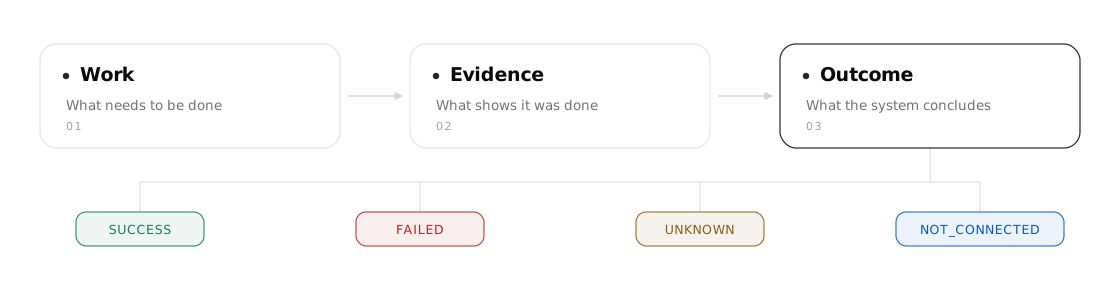
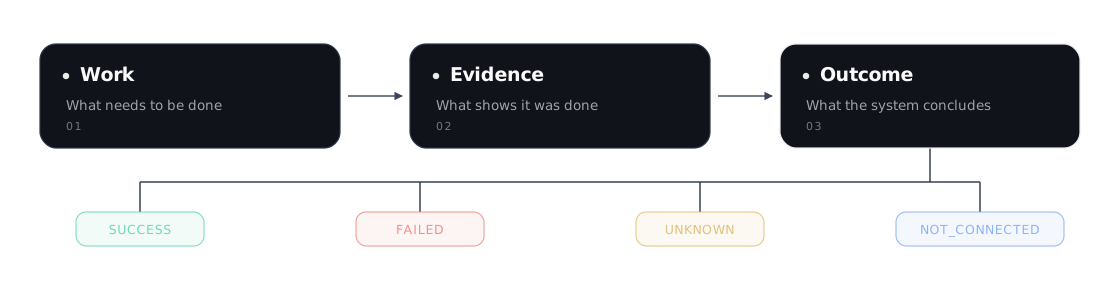
The complete record of a piece of work: Work states the goal, Evidence provides proof that can be read back, and Outcome is the conclusion the system draws from it — including “unable to confirm.”
Most teams first meet AI through a chat box: ask a question, copy the answer. That path is short and genuinely useful, but it stops at the individual. Once a piece of work needs several people, a record, and someone accountable for it, a chat box is no longer enough.
VINCIS GPT is built for that second half of the problem: turning AI from “a tool that answers questions” into “a collaborator that takes part in the work, leaves evidence, and accepts oversight.” This article explains its basic structure and how a team typically brings it into everyday work.
Key takeaways
- All work is modeled as three objects: Work (what needs to be done), Evidence (what shows it was done), and Outcome (the result the system determines from that evidence).
- An AI Employee has the ability to execute, but not the authority to approve — the system keeps the two separate.
- “No data found” and “read failed” are two different states, and the system never treats the second as the first.
- Conversations do not automatically become company knowledge; an official fact needs a source, context, and a basis for confirmation.
Why “using AI” and “having AI take part in the work” are not the same
Using AI asks very little: you ask, it answers, you decide whether the answer helps. Responsibility is clear throughout — the judgment is yours, and so is the risk.
But once AI starts acting on your behalf — sending an email, updating a record, calling an external service — that line blurs. Who authorized it? Did it actually succeed? What shows that it succeeded? Who is responsible if something goes wrong? A chat box has no answers to these questions, because a chat box holds only text, not state.
A model saying “done” and the thing actually being done are two different pieces of information.
VINCIS GPT starts from one premise: a model’s account of its own actions is not proof of execution. Whether a piece of work is complete depends on whether the system can obtain independent evidence that can be read back — not on how the answer is worded. The premise sounds conservative, but it shapes the structure of the entire system.
Three core objects
To make work something that can be tracked, VINCIS GPT describes it with three objects.
Outcome has only four possible values, and it deliberately keeps a slot for “we don’t know”:
| Status | Meaning | System behavior |
|---|---|---|
SUCCESS | Sufficient evidence shows the goal has been met | Records the evidence source and closes the Work |
FAILED | There is evidence that the execution failed | Preserves the failure state for follow-up |
UNKNOWN | Available information cannot confirm success or failure | Stops and asks for verification; does not retry |
NOT_CONNECTED | The required execution or verification capability is not yet connected | States the gap plainly; never uses simulated data |
Most systems either count a read timeout as a failure or simply treat it as if nothing went wrong. Both create false certainty. Keeping UNKNOWN means the system admits what it does not know. The cost is one extra manual check; the benefit is never building on a wrong conclusion.
How an AI Employee joins the team
An AI Employee is an executing agent that has been assigned responsibilities and capabilities. It can take on tasks, break down problems, propose plans, call tools within the scope it is allowed, carry out work that has already been authorized, and record the entire process.
What it cannot do is just as clearly defined — and these limits are not conventions written into a prompt, but constraints enforced by the system:
- It cannot impersonate a person or give approval in a person’s name;
- It cannot grant itself higher privileges or approve its own tasks;
- It cannot write model output directly into company facts;
- It cannot declare a task successful without valid evidence.
In other words, what an AI Employee can do and what it is permitted to decide are two independent things. Being able to call a tool does not mean having the right to decide when it should be called.
Permissions and approval: who decides what
The system distinguishes four concepts that are often conflated:
- Execution capability — which tools it can use and which kinds of tasks it can handle.
- Request permission — whether it may submit a given request. Submitting a request is not the same as approving it.
- Owner authority — comes only from an identity record that the system has formally appointed and verified.
- Approval decisions — must come from a real, verified person who has the authority to make that decision.
One point deserves particular emphasis: email addresses, display names, job titles, role labels, and organization names confer no authority. They are contact and display information, not credentials. An account that names itself admin@ has no relationship whatsoever to an Owner record in the permission system.
# Order of permission checks, simplified
verify  identity      → a verified identity record in the system
check   capability    → whether this agent can perform this kind of action
check   authorization → whether this action has valid authorization
require approval      → high-risk actions need confirmation from a person
record  evidence      → the result must be readable back

# If any step cannot be confirmed → refuse or pause, never proceed
For external publishing, sending messages, payments, permission changes, or handling sensitive information, the system requires confirmation or approval. Without valid authorization, it refuses to act — that is not a malfunction; it is the design.
Company knowledge is not chat history
The longer a team uses the system, the more one question comes up: what actually counts?
VINCIS GPT answers it by keeping the two apart. Conversations, model guesses, and AI-generated text are not company facts by default. To become official knowledge, a piece of information needs a clear source, context that can be reconstructed, and an appropriate basis for confirmation. Information that cannot be confirmed stays unknown; it is never automatically filled in to look like a complete answer.
In practice, this rule means the knowledge base does not get polluted as usage grows. It grows more slowly, but everything it adds can be cited.
From trial to everyday use: a workable pace
Most teams do not need to adopt everything at once. A steadier approach takes three steps:
- Start with read-only work. Research, search, organizing, analysis — these tasks have no external side effects, and the cost of a mistake is simply redoing them. They are a good way to build a feel for output quality.
- Then connect one or two connectors. Choose systems whose results you can verify, confirm the scope of authorization, the target of each action, and any possible side effects, and then watch whether the Evidence can really be read back.
- Automate last. Only once the first two steps have produced enough trustworthy records should you discuss which steps can require less manual confirmation.
Do not let AI alone make decisions that could seriously affect a person’s life, health, significant rights, or legal status. Judgments involving law, medicine, finance, tax, safety, or personnel should be reviewed by people with the appropriate qualifications.
Common misconceptions
“The output looks professional, so it must be fine.” Fluency and accuracy are two different things. A language model produces well-structured answers even when it is uncertain, which is exactly why they need to be checked.
“It said the call succeeded.” Check the Evidence and the Outcome. The proof of execution the system provides and the model’s description of that execution are not the same thing.
“This feature runs locally, right?” Do not assume so unless it is explicitly marked as local-only. The exact boundaries depend on the feature you use, how it is deployed, and which services it calls.
The hard part of bringing AI into work has never been getting it to speak; it is making what it says verifiable. Most of the design in VINCIS GPT is built around exactly that.
Give VINCISGPT a real piece of work
Bring your own case and watch it break the task down, gather the evidence and return a result you can check.